
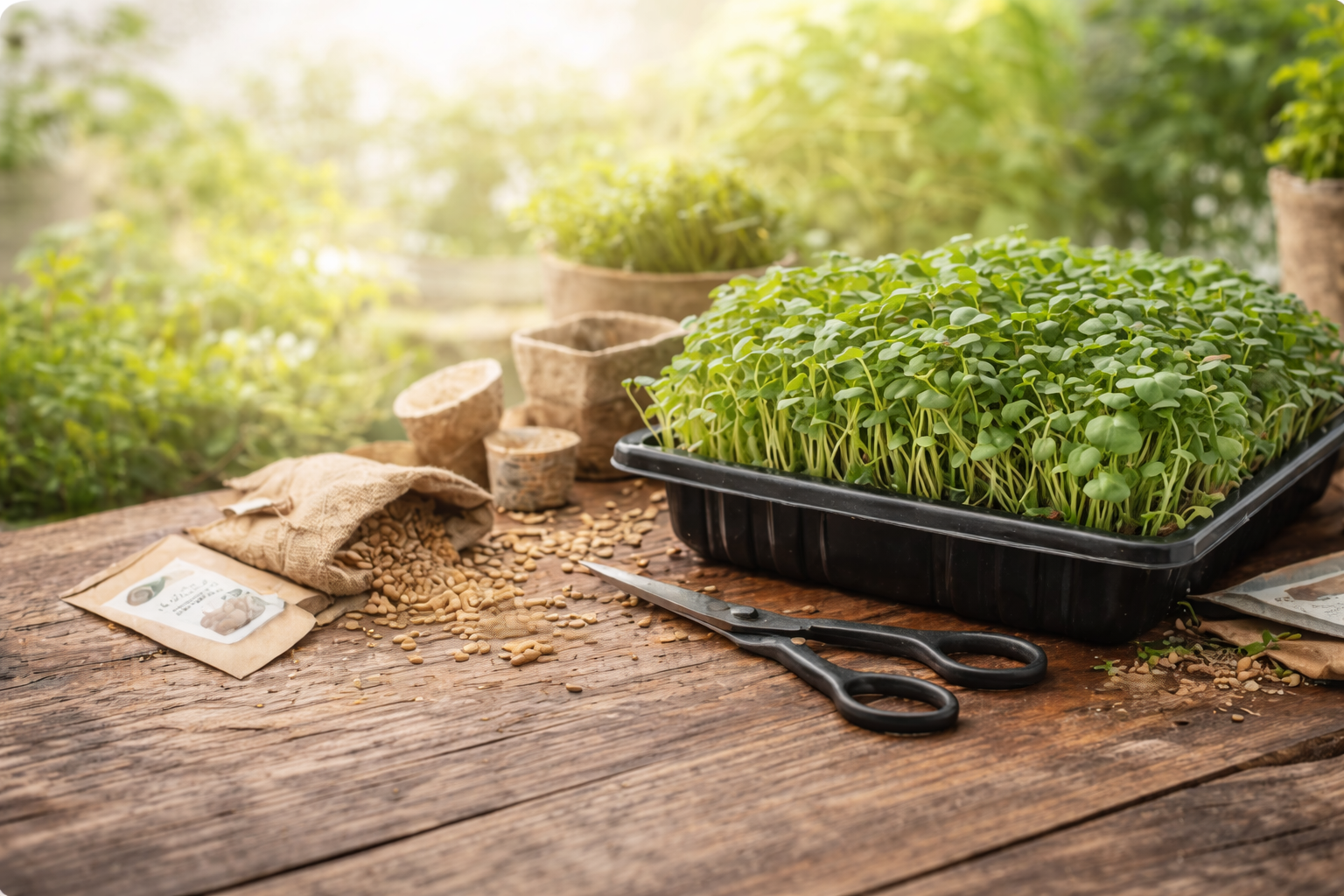
Microgreens: The Easiest Way to Grow Fresh, Homegrown Superfoods in Just 14 Days
**Microgreens are nutrient-dense superfoods that can be grown at home in under 3 weeks (typically 7-21 days) using simple trays, soil or mats, seeds, and a sunny window or grow lights.**[1][4][8]
### Key Benefits as Homegrown Superfoods
Microgreens like broccoli, pea shoots, radish, and sunflower are harvested young for maximum flavor and nutrition, often 40 times more nutrient-packed than mature plants, adding fresh greens to salads, sandwiches, or bowls.[3][10]
### Essential Supplies
– **Shallow trays**: 10×20 flats, pots, or recycled containers (one with drainage holes over a solid bottom tray).[1][4][8]
– **Growing medium**: 1-2 inches of moistened potting soil, coco coir, or hydroponic mats (hemp, jute, coconut).[1][3][4][6]
– **Seeds**: Microgreen varieties (e.g., broccoli, pea, radish); choose untreated seeds.[2][4][6]
– **Other**: Spray bottle, weights for germination, sunny window or grow lights (6-8 hours/day).[1][3][7]
### Step-by-Step Growing Guide (7-21 Days Harvest)
1. **Prepare medium**: Fill tray with 1-2″ moist soil or soaked mat; flatten gently.[1][3][7][8]
2. **Soak seeds** (optional, especially larger ones like peas/sunflowers): 6-8 hours or overnight for uniform germination.[3][6][10]
3. **Sow densely**: Scatter seeds evenly to cover soil (no gaps or clumps), press into medium; mist top.[1][6][7][8]
4. **Germinate (2-4 days)**: Cover with lid/another tray/weight for blackout; keep moist in dark spot.[1][4][7]
5. **Grow (3-17 days)**: Uncover once rooted; place in light (window or 3-5″ under grow light); mist or bottom-water 1-2x/day.[1][3][7]
6. **Harvest**: Cut stems above soil when true leaves appear (7-21 days total); store refrigerated up to 2 weeks.[2][4][6]
### Tips for Success
– Maintain even moisture to prevent mold; use fresh medium each cycle.[4][5]
– Rotate varieties/crops for soil health if reusing.[5]
– Experiment with density using calculators for optimal yield.[4]
– No full greenhouse needed; windowsill works.[1]
Download the 6 Easy-to-Grow Microgreens eGuide here:
Once you experience your first harvest, you’ll likely wonder why you didn’t start growing microgreens sooner.
sources:
- [1] PMC article (PMC12662059): Reviews microgreens production techniques, hydroponics, indoor farming; notes growth under various conditions including light effects on biomass and harvest timing.
https://pmc.ncbi.nlm.nih.gov/articles/PMC12662059/ [1] - [2] PMC article (PMC11225695): Discusses cultivation practices (temperature, media, hydroponics vs. soil), growth parameters, and bioactive compounds; highlights 50% biomass increase with treatments.
https://pmc.ncbi.nlm.nih.gov/articles/PMC11225695/ [2] - [3] Annual Reviews journal: Covers microgreens for home, commercial, and space farming with recent developments.
https://www.annualreviews.org/[3] - [4] TheMightyMicrogreen.com compilation: Exhaustive list of research articles on nutrition, cultivation (e.g., 14-day projects), including Wang & Xiao (high nutrient levels) and Penn State on functional foods.
TheMightyMicrogreen.com [4] - [5] Frontiers in Genetics (2023): Prospects of microgreens as functional food; cultivation practices, hydroponics vs. soil comparisons, growth cycles with minimal waste.[5]
- [6] International Journal of Plant & Soil Science (2025): Review on cultivation, nutrition, urban farming, space applications; emphasizes small-scale adaptability and timelines.
https://journalijpss.com/index.php/IJPSS